
Practice Like Test Day. Walk In Ready.
How I Verify Exam Questions
Be Certified Today is built for exam prep in the browser: timed simulation, adaptive review, and practice organized by exam objective. Every question bank starts from the official exam topics PDF, maps to blueprint objectives, and is checked against vendor documentation when certifications update.
Why Accuracy Is the Product
If a Test Preparation Site trains you on the wrong objectives, or keys answers from unreliable sources, it does not prepare you for test day. You lose study time. You lose confidence when the real exam asks something the bank never covered.
I treat question quality as engineering, not filler. I build from the vendor blueprint, compare PDF versions when they change, research learner pain points across discussion sites, verify every key on Tier A documentation, weight banks to domain percentages, and retire items that no longer belong on the current exam. That is how the practice stays tied to the exam version you are studying for.
Start With the Official Exam Topics PDF
Every track on this Test Preparation Site names the blueprint version I build against: CCNA V_2025 and V_2026, CCNAAUTO v1.1, Security+ SY0-701 objectives, and so on. The PDF is the contract for what can appear on the exam.
When I add or revise a question, the first check is simple: does this objective still exist on the current PDF? I paraphrase stems. I do not copy vendor wording verbatim. The skill being tested must map to a line in the official topics document.
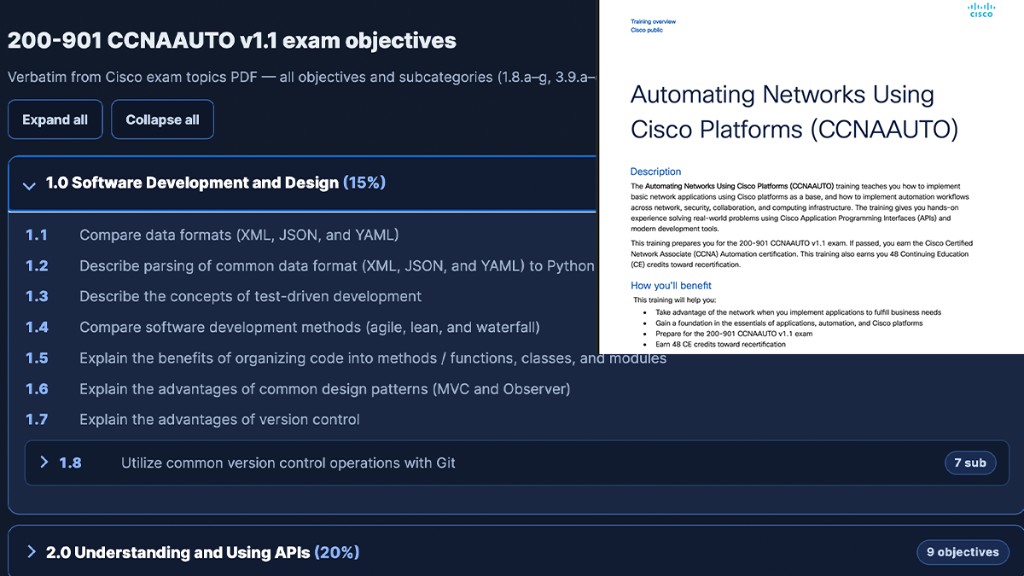
Example verification capture: site objective map beside Cisco training overview.
Compare PDF Versions When Blueprints Update
Cisco and CompTIA publish revised exam topics. When they do, I diff the new PDF against the prior version. I track renames, splits, removals, and weight changes. I do not guess from forum chatter.
Example: Security+ moved from SY0-601 to SY0-701 with domain changes, renamed objectives, and topics that no longer belong in the active path. I record those changes so every affected question is reviewed, rewritten, retagged, or moved into the outdated archive.
The same discipline applies across tracks. CCNA uses explicit version tags (V_2025 vs V_2026) when Cisco updates the 200-301 blueprint. Security+ follows CompTIA’s published objective domains for SY0-701.
Replace with: Security+ sample showing SY0-601 to SY0-701 objective comparison, retired topics, or the internal change log used to decide whether an item stays active, gets rewritten, or moves to the archive.
1200×800 · ≤ 200 KB · /images/verification/
Verify Keys on Credible Vendor Sources
Discussion forums help me see which topics learners struggle with. Correct answers and explanations are still verified on official Tier A documentation - not forum votes, dump keys, or “what was on my test” threads.
-
Tier A: use for keys
Cisco documentation, Cisco Learning Network, DevNet (for automation/API items), and CompTIA official learning resources for Security+, plus NIST and RFCs where the blueprint points there. These sources define how the vendor expects the topic to be understood.
-
Not used as answer keys
Exam dumps, braindump forums, and anonymous “actual exam” answer keys. They may be wrong, outdated, or misaligned with current objectives. Discussion sites inform topic research; they do not replace Tier A verification of the key.
Research First - Not AI-Generated Banks
Practice items are not mass-produced by AI. Questions are pulled from dozens of discussion sites, then weighted for still-valid coverage on the current blueprint, and only ship when keys check out on highly ranked Tier A documentation.
- Poll & research: scan discussion sites for recurring weak topics, confusing stems, and SY0-701 coverage gaps
- Weight for validity: drop or rewrite anything that only matched an old blueprint or a stale answer
- Verify the key: confirm the answer and explanation on CompTIA / NIST / RFCs and other Tier A sources
- Tag & ship: objective ID on every item; legacy material stays out of active pools
That is the opposite of dumping an AI question list online. Research finds the pressure points; Tier A sources own the answer.
Tag Every Question: Version, Objective, Sub-Objective
Each practice item carries metadata so I know exactly what it tests and which blueprint it belongs to.
- Blueprint version: e.g.
v1.1,V_2026,SY0-701 - Objective ID: domain and line from the exam topics PDF
- Sub-objective: when the PDF lists child bullets, I tag those too
- Verification record: date checked and Tier A source used (internal topic map; not shown on every question page)
Tagging is what makes domain-weighted banks and obsolete handling possible. Without it, you cannot tell whether a random 100-question set actually matches the exam mix.
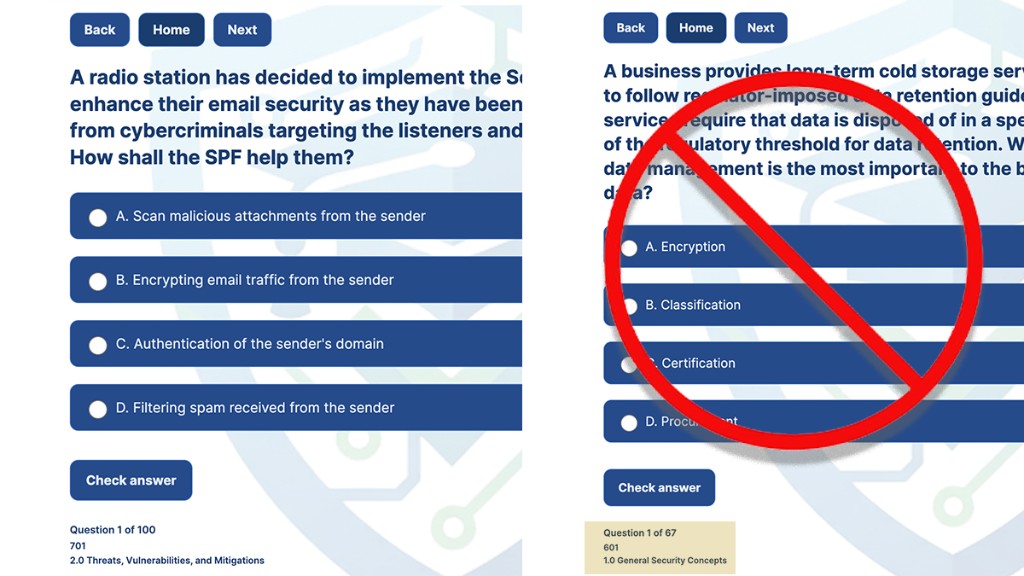
Example tagging control: active items carry current blueprint metadata, while outdated items stay out of the active path.
Build 100-Question Banks to Domain Weights
Full practice banks target 100 questions per bank, with counts per domain matching the official percentage weights on the exam topics PDF, not an arbitrary pile of items.
CCNA Automation v1.1 example (percentages from the official blueprint):
| Domain | Exam weight | Target per 100 Q |
|---|---|---|
| 1.0 Software development and design | 15% | 15 |
| 2.0 Understanding and using APIs | 20% | 20 |
| 3.0 Cisco platforms and development | 15% | 15 |
| 4.0 Application deployment and security | 15% | 15 |
| 5.0 Infrastructure and automation | 20% | 20 |
| 6.0 Network fundamentals | 15% | 15 |
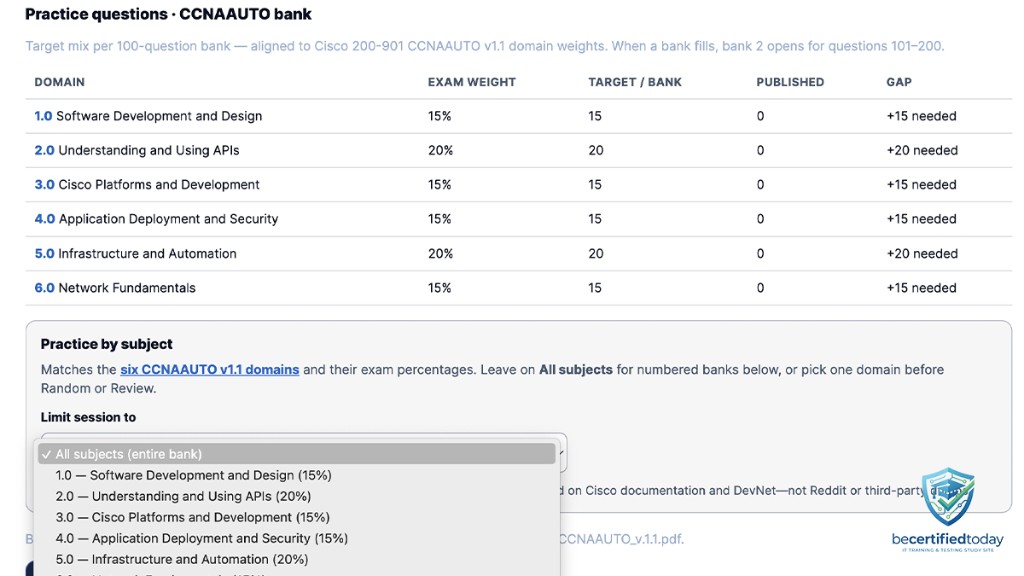
Example bank control: domain weights, target counts, gap tracking, and subject filtering.
Label Obsolete Questions and Keep Them Out of Active Banks
When an objective drops from the current blueprint, related questions do not silently stay in rotation. They move to an obsolete archive: documented, tagged, and excluded from default weighted random and review pools for the current exam.
On CCNA, version filters (V_2025 vs V_2026) let you practice against the blueprint you are sitting. Items that only applied to an older version remain available for historical review if needed, but they are not mixed into current-exam practice as if nothing changed.
Obsolete handling is part of honest test prep: you should not drill skills the vendor removed from the objectives while believing you are studying for tomorrow’s exam.
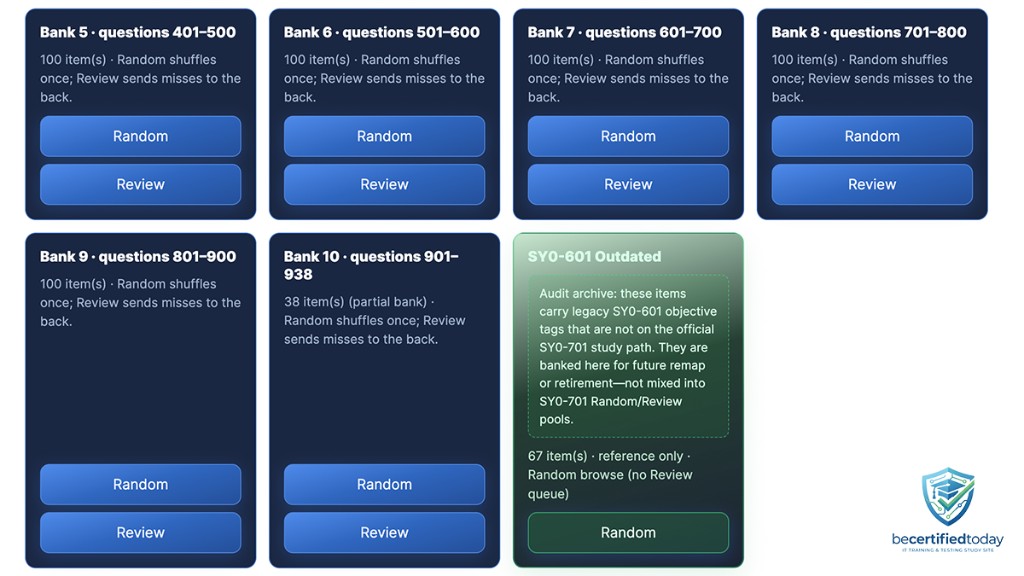
Example archive control: outdated SY0-601 items remain available for reference, not mixed into active SY0-701 review.
The Verification Workflow, End to End
Eight steps every new or updated question goes through before I ship it in an active bank.
- Start with the current official exam topics PDF and note the blueprint version.
- Compare PDF versions when the vendor publishes an update; log renames and removals.
- Pull questions from dozens of discussion sites (practice items - not dump keys).
- Author paraphrased stems and map to objective + sub-objective IDs - not AI-generated banks.
- Weight for still-valid SY0-701 coverage; drop stale or blueprint-mismatched items.
- Verify the key and explanation on highly ranked Tier A vendor documentation.
- Slot into a 100-question bank at the correct domain weight.
- Retire items tied only to dropped objectives into the obsolete archive.
Practice That Matches What You Will Be Tested On
Choose the exam track you are preparing for. Each track page has the previews, pricing, and access path for that exam.